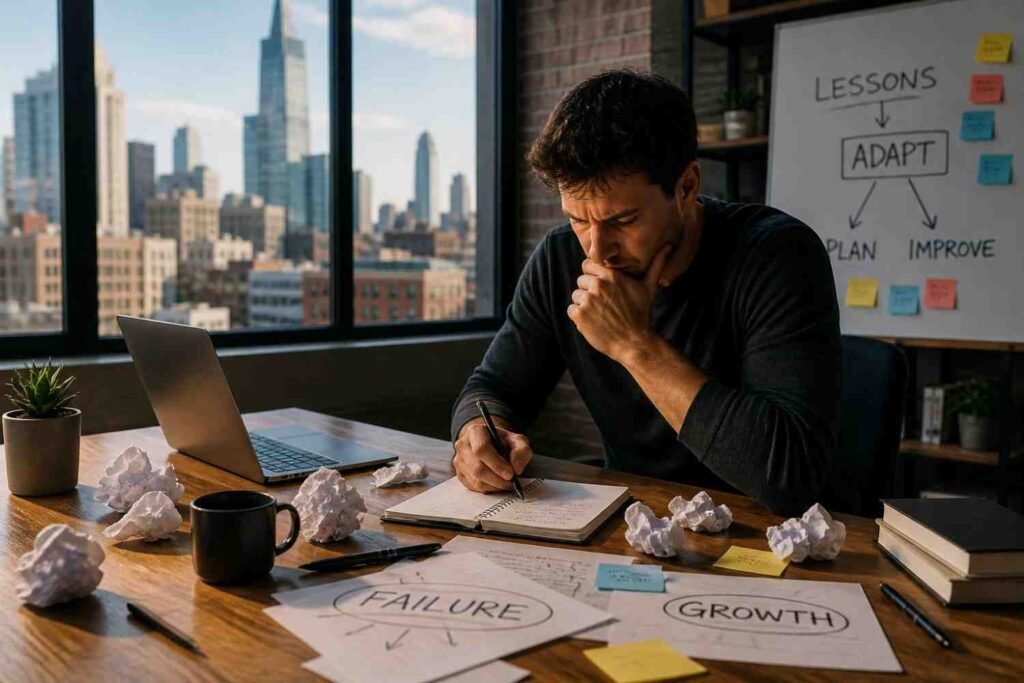
Failure hits differently when it’s your own business. It’s not just numbers going down or a product not working; it’s time, money, and belief all colliding at once. I’ve seen founders try to avoid it at all costs, stretching decisions, overthinking moves, and still ending up in the same place. The real shift doesn’t happen when you succeed. It happens the moment you stop treating failure like a verdict.
What changes everything is how you interpret what went wrong. Instead of shutting down or jumping to the next idea, you start looking at failure as raw data. Not emotional, not personal, just information. That’s where learning from failure in business stops being a phrase and starts becoming a system.
The Real Shift: From Fear-Based Thinking To Learning Cycles
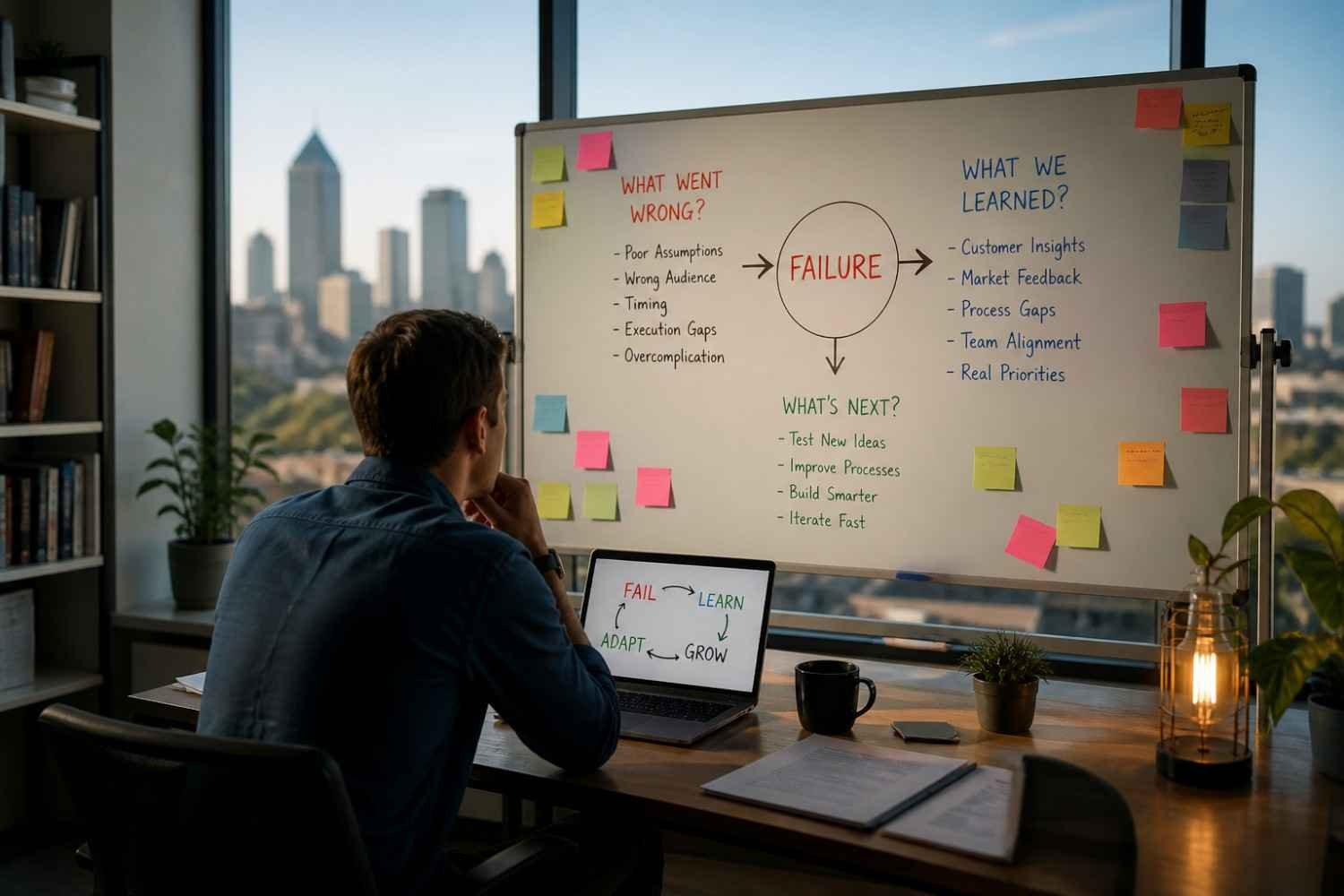
Most early decisions in business are driven by fear. Fear of losing money, fear of looking incompetent, fear of making the wrong call. That fear leads to safe choices, delayed execution, and sometimes even ignoring clear signals.
But the shift happens when you stop asking, “What if this fails?” and start asking, “What will this teach me if it does?”
This is where a growth mindset starts showing up in real decisions, not just in theory. You begin to:
- Treat outcomes as feedback, not identity
- See mistakes as part of iteration, not failure
- Move faster because perfection is no longer the goal
One of the biggest mindset flips is moving from fault to feedback. Instead of blaming people or circumstances, you focus on extracting insight. This alone changes how teams operate and how founders make decisions under pressure.
Failure As Expensive Market Research

There’s a reason so many businesses fail; it’s not always poor execution, it’s often misreading demand. When something doesn’t work, it’s easy to call it a bad idea. But more often, it’s an incomplete understanding.
Think of failure as “paid insight.”
Every failed launch, poor conversion, or abandoned feature tells you something:
- Your audience didn’t see value
- Your timing was off
- Your messaging didn’t connect
- Your assumptions were wrong
Instead of discarding the effort, you extract the signal. That’s how learning from failure in business becomes a strategic advantage instead of a setback.
Fail Fast, But Learn Faster

Speed alone doesn’t help if you’re repeating the same mistakes. What actually works is running small, controlled experiments and learning from each one.
This is where a more scientific approach comes in:
- Test ideas on a smaller scale before committing resources
- Measure outcomes clearly
- Adjust quickly based on real feedback
The goal isn’t to avoid failure. It’s to reduce the cost of learning.
Many founders struggle here because they either move too slowly or jump too fast without reflection. The balance is in quick execution followed by honest evaluation.
How You Start Building Differently

Once this mindset shift happens, your entire approach to building changes. You stop chasing perfection and start optimizing for learning.
1. You Stop Hiding What’s Not Working
There’s a tendency to “clean up” numbers or ignore weak signals to maintain confidence. But that delays real progress.
Instead, you:
- Acknowledge unstable systems early
- Accept long cycle times as signals, not problems to hide
- Look at the data as it is, not how you want it to be
Transparency becomes a tool, not a risk.
2. You Learn To Classify Failure
Not all failures are the same, and treating them equally slows you down.
You start distinguishing between:
- Preventable failures – mistakes in known processes
- Complex failures – unpredictable interactions in systems
- Intelligent failures – calculated risks taken to learn something new
This helps you respond better. You fix what’s broken, understand what’s unclear, and encourage what leads to innovation.
3. You Run Better Retrospectives
Instead of moving on quickly, you pause and analyze.
A simple but effective method is asking “why” repeatedly until you reach the root cause. Not the obvious reason, the actual one.
These “failure autopsies” are not about judgment. They’re about clarity.
Over time, this builds a pattern-recognition ability that most founders don’t develop early enough.
4. You Build Psychological Safety In Teams
If people are afraid to speak up about mistakes, you lose critical information.
Creating a space where it’s safe to admit errors leads to:
- Faster issue detection
- Better collaboration
- More honest decision-making
Teams that hide mistakes move more slowly than teams that surface them early.
The Hidden Advantages Most People Miss

Failure doesn’t just teach tactical lessons. It reshapes how you think and operate.
You Develop Real Self-Awareness
Success can hide weaknesses. Failure exposes them clearly.
You start seeing:
- Where your judgment was off
- What you overestimated
- What you ignored
This leads to better decisions, not just better strategies.
You Get Better At Using Resources
After a failure, you become more intentional.
Instead of spreading resources thin, you:
- Prioritize what actually moves outcomes
- Allocate time and money more precisely
- Avoid unnecessary complexity
This shift alone can change how efficiently you build.
You Build Emotional Capacity
There’s a difference between knowing failure is part of business and actually experiencing it.
Once you’ve been through it:
- You handle pressure differently
- You make decisions with more clarity
- You stop reacting emotionally to every setback
This is where resilience becomes practical, not theoretical.
And this is also where founders start understanding how to stay focused as a founder even when things feel uncertain or chaotic.
FAQs: Learning From Failure In Business: The Shift That Changes How You Build
1. What does learning from failure in business actually mean?
It means treating mistakes and setbacks as data points. Instead of avoiding failure, you analyze it to improve decisions, strategy, and execution going forward.
2. Why do so many businesses fail early?
A major reason is misreading market demand. Many businesses build something without fully understanding what customers actually need or value.
3. How can founders deal with failure emotionally?
By separating identity from outcomes. Viewing failure as feedback rather than a personal flaw helps reduce emotional stress and improves clarity in decision-making.
4. What is an intelligent failure in business?
An intelligent failure is a calculated risk taken to learn something new. It’s intentional, controlled, and designed to generate insight rather than avoid mistakes completely.
Final Thoughts
Failure changes how you think if you let it. Not in a dramatic, overnight way, but in small, consistent shifts. You start questioning assumptions earlier, testing ideas faster, and reacting less emotionally to setbacks. Over time, this compounds into better decisions and stronger systems. The real difference isn’t that failure disappears, it’s that it stops controlling how you build.
Once you see failure as part of the process, not the end of it, everything starts moving with more clarity.