
Most people think business growth comes from better strategies, smarter marketing, or more capital. That’s partially true, but it’s not where things actually start. What really drives growth, especially in the early stages, is how you think when things aren’t working.
In my experience, the difference between businesses that grow and those that stall isn’t effort; it’s interpretation. Two people can face the same setback. One sees a dead end. The other sees data. That shift, small as it sounds, is where everything begins.
Why Mindset Becomes The Foundation Of Business Growth

There’s a point early in any business where things stop being predictable. Plans don’t play out exactly. Customers behave differently from what was expected. That’s where mindset stops being a “soft skill” and starts becoming operational.
Psychologist Carol Dweck introduced the idea of a growth mindset, but in business, it goes deeper than belief it affects decision-making speed, risk tolerance, and how long you stay in the game.
A rigid mindset leads to hesitation. A growth-oriented one leads to iteration.
And over time, iteration compounds.
The Core Shift: From Outcome Thinking To Learning Thinking
One of the biggest mindset traps is tying your progress only to results. Revenue, traction, scale, these matter, but they’re lag indicators.
A stronger mindset focuses on:
- What did this attempt teach me?
- What assumption was wrong?
- What can be adjusted immediately?
This is where businesses quietly start improving while others stay stuck waiting for perfect outcomes.
It also connects deeply with creative thinking in entrepreneurship because when you stop fearing wrong answers, you start exploring better ones.
The “Day One” Mentality That Keeps You Moving

Leaders like Jeff Bezos built entire systems around staying in what he called “Day 1.” The idea is simple: operate with the urgency and curiosity of someone who has just started.
The opposite of what he referred to as “Day 2” looks like:
- Complacency
- Slower decisions
- Over-reliance on past success
When you treat every stage of your business like it’s still fragile, you stay alert. You test more. You question more.
And that keeps growth alive.
Reframing Failure So It Actually Becomes Useful
Failure in business is unavoidable. But what’s optional is how you interpret it.
Instead of seeing failure as a verdict, it helps to treat it as an experiment result.
For example:
- A campaign that didn’t convert → messaging insight
- A product that didn’t sell → demand signal
- A lost client → positioning feedback
Calling failure “fascinating” instead of “frustrating” might sound subtle, but it changes your reaction. You move from avoidance to curiosity.
And curiosity leads to better decisions.
The Shift From “Knowing” To “Learning”
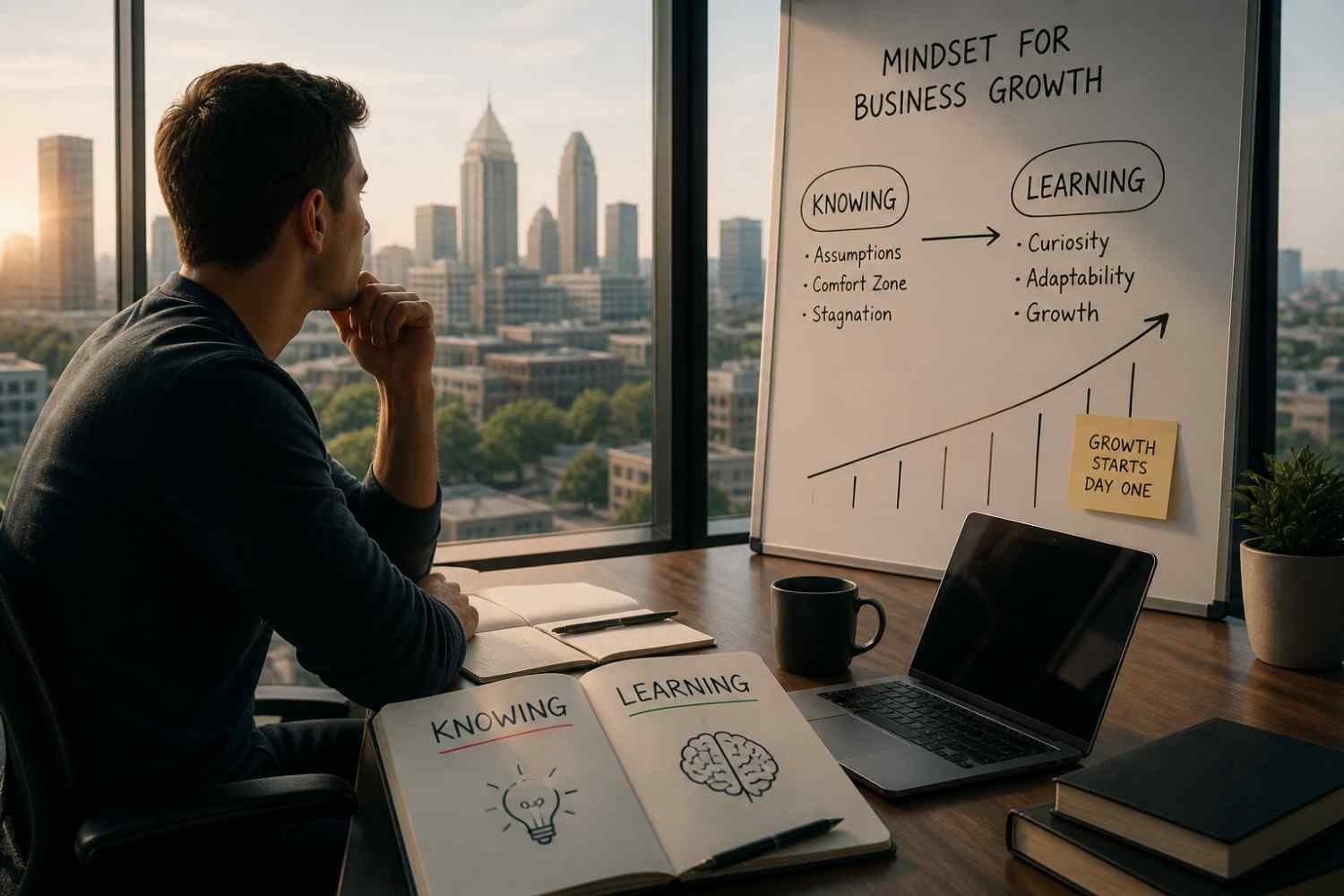
There’s a quiet danger in becoming too confident too early. When you start thinking like an expert, you stop updating your thinking.
That’s why many modern companies, including Microsoft, push a “learn-it-all” culture instead of a “know-it-all” one.
In practical terms, this means:
- Questioning your own assumptions regularly
- Staying open to feedback (even when it’s uncomfortable)
- Adapting faster than your competition
A learning mindset doesn’t mean uncertainty it means flexibility.
Practical Ways To Build The Right Mindset Early
Mindset isn’t built in one moment. It’s shaped daily, through small patterns that either reinforce growth or resistance.
Here are a few that actually make a difference:
- Pay attention to your internal language
Replace “I’m not good at this” with “I’m not good at this yet.” It sounds simple, but it changes how your brain processes challenges. - Take action before you feel ready
Waiting for perfect clarity slows everything down. Progress usually comes from imperfect execution. - Create space for daily input
Whether it’s reading, listening, or observing, your thinking needs new inputs to evolve. - Build a circle that challenges you
Growth accelerates when you’re around people who think differently and push you out of default patterns. - Focus on consistency over intensity
One strong week doesn’t build a business. Repeated, steady effort does.
Why Process Thinking Outlasts Motivation

Motivation is unreliable. Some days you’ll have it. Most days you won’t.
That’s why focusing on the process matters more than chasing outcomes.
When your mindset is tied to:
- Showing up daily
- Testing consistently
- Improving incrementally
You stop depending on how you feel. You start depending on what you do.
And that’s far more stable.
How This Mindset Shows Up In Real Decisions
This isn’t just theory; it shows up in how you operate daily.
For example:
- Do you delay launching because it’s not perfect?
- Do you avoid trying new channels because they might fail?
- Do you stick to what worked once instead of adapting?
These are all mindset decisions disguised as business decisions.
And over time, they either limit or expand your growth.
Frequently Asked Questions: Developing The Right Mindset For Business Growth From Day One
1. What is the best mindset for business growth?
A growth-oriented mindset focused on learning, adaptability, and long-term thinking works best. It allows you to treat challenges as feedback rather than failure.
2. How does mindset affect business success?
Mindset influences how you make decisions, handle setbacks, and take risks. A strong mindset helps you stay consistent and improve over time.
3. Can mindset really impact business growth?
Yes, because your thinking shapes your actions. Repeated actions directly impact results, especially in the early stages of a business.
4. How can entrepreneurs improve their mindset?
By focusing on learning, taking consistent action, surrounding themselves with the right people, and staying open to feedback and change.
Final Thoughts
Building the right mindset for business growth isn’t about staying positive or repeating affirmations. It’s about how you interpret reality when things don’t go as planned. It’s about choosing to see patterns instead of problems, and opportunities instead of obstacles.
Your business will only grow as fast as your thinking evolves. And that evolution isn’t automatic, it’s something you actively build, one decision at a time.
