
Small business vendors often manage sales, invoices, inventory, customer messages, follow-ups, marketing, and supplier coordination with limited time and staff. Automation tools help reduce this workload by turning repetitive manual tasks into systems that run in the background.
The right automation stack can improve accuracy, speed up customer response times, reduce admin costs, and help vendors scale without hiring too quickly. In 2026, the best automation tools for small business vendors are usually no-code, affordable, integration-friendly, and increasingly supported by AI.
What Are Small Business Automation Tools?
Small business automation tools are software platforms that perform routine tasks with minimal human input. These tasks may include sending emails, updating customer records, creating invoices, scheduling social media posts, routing approvals, tracking payments, or syncing data between apps.
For vendors, automation is especially useful because daily operations often involve repeated processes. Every new order, quote request, customer inquiry, invoice, or shipment can trigger a series of steps. Instead of doing each step manually, automation tools make the process faster and more consistent.
Why Vendors Should Use Automation
Automation is not just about saving time. It also improves how your business operates. When workflows are automated, fewer tasks fall through the cracks, data entry errors decrease, and customers receive faster responses.
For small vendors, the biggest benefits include:
- Time savings on repetitive admin work
- More accurate invoices, records, and follow-ups
- Faster customer communication and better service
- Lower operating costs as the business grows
- Better scalability without adding unnecessary headcount
This makes automation one of the simplest ways to increase productivity without overwhelming your team.
Best Workflow Automation Tools
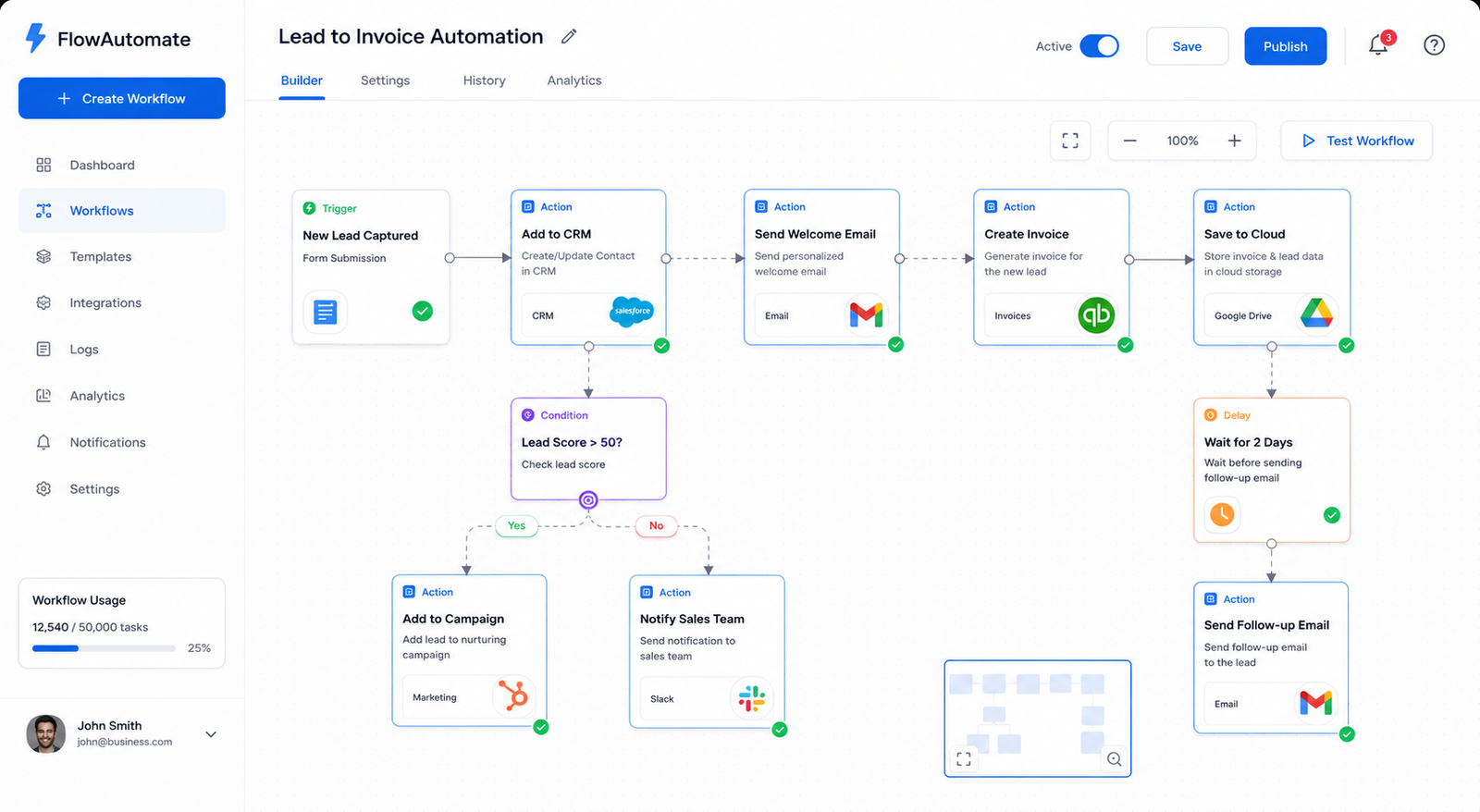
Workflow automation tools connect different apps and create “if this happens, then do that” processes. These are often the first tools small vendors should explore because they work across multiple business functions.
Zapier remains one of the most popular options because it connects thousands of apps and is easy for non-technical users. It is ideal for simple automations such as adding website leads to a CRM, saving email attachments to cloud storage, or sending alerts when a new order arrives.
Businesses looking to improve operational efficiency can also explore workflow automation best practices for building scalable automated systems.
Make is a strong choice for vendors that need more complex workflows. Its visual builder makes it easier to design multi-step automations with conditions, filters, and branching logic. Make is often preferred by teams that want more control than Zapier offers.
n8n is a good fit for more technical businesses that want open-source flexibility or self-hosting. It offers deeper customization and can be useful for vendors that care about data control and advanced integrations.
Activepieces is another emerging option, especially for users who want open-source automation with AI-supported workflows. It is useful for small teams experimenting with automation without committing to expensive enterprise tools.
CRM and Sales Automation Tools

Customer relationship management tools help vendors track leads, customers, deals, and follow-ups. A good CRM prevents missed opportunities and improves sales consistency.
Businesses building long-term supplier partnerships should also understand legal tips for working with vendors to reduce operational and contract risks
HubSpot is one of the most widely used CRM options for small businesses. It offers contact management, email automation, lead tracking, forms, and sales pipeline tools. Its free CRM makes it attractive for vendors starting with automation.Keap is built for small businesses that need sales and marketing automation in one system. It helps manage bookings, nurture leads, send follow-ups, and automate customer journeys.
Bitrix24 combines CRM, communication, task management, and collaboration features. It can work well for vendors that want an all-in-one platform instead of separate tools.
Trellus is useful for lean outbound sales teams that need help with prospecting and follow-up workflows. For vendors that actively sell to other businesses, these tools can reduce manual outreach time.
Marketing and Social Media Automation Tools
Marketing automation helps vendors stay visible without manually posting, emailing, or following up every day.
Mailchimp is a strong choice for email marketing automation. Vendors can use it to send welcome emails, newsletters, product updates, abandoned cart reminders, and segmented campaigns.
Buffer and Hootsuite help schedule social media content across multiple platforms. These tools are useful for vendors that rely on consistent brand visibility but do not have time to post manually every day.
ManyChat is valuable for businesses that communicate with customers on Instagram, Facebook Messenger, or WhatsApp-style channels. It can automate common responses, product questions, and lead capture conversations.
HubSpot can also support marketing automation by connecting CRM data with email campaigns, forms, landing pages, and lead nurturing workflows. Recent 2026 software roundups continue to highlight HubSpot and Mailchimp among leading marketing automation options for small businesses.
Finance and Accounting Automation Tools
Financial automation is one of the highest-impact areas for vendors because invoicing, expense tracking, and reconciliation can consume hours every week.
QuickBooks Online is a leading small business accounting platform. It can automate invoicing, expense categorization, bank reconciliation, financial reports, and payment tracking.
Vendors aiming to improve cash flow management should also understand small business financial planning strategies to support long-term growth.
Xero is another popular accounting tool, especially for businesses that want strong integrations with third-party apps. It works well for vendors managing multiple platforms or international workflows.
FreshBooks is known for simple invoicing and client billing. It is especially useful for service-based vendors, freelancers, consultants, and small agencies.
These tools help vendors maintain healthier cash flow by sending invoices quickly, reminding customers about payments, and keeping records accurate.
AI-Powered Automation Tools

AI automation is becoming more practical for small vendors. Instead of only connecting apps, AI tools can summarize emails, draft replies, schedule meetings, classify leads, and update records.
Lindy is designed around AI agents that can help with scheduling, email management, CRM updates, and routine admin tasks.
Phantombuster is useful for lead generation workflows, such as extracting prospect data from online platforms and sending it into a sales system.
Modern workflow platforms like Zapier, Make, and n8n are also adding more AI features, making it easier to build automations that include text generation, data extraction, or intelligent routing. Some 2026 automation guides continue to rank Zapier, Make, and n8n as core options for small business workflow automation.
Best Practices for Using Automation Tools
The biggest mistake small vendors make is trying to automate everything at once. This creates confusion and often leads to broken workflows.
Start with one painful process, such as invoice reminders, customer follow-ups, appointment scheduling, or order notifications. Document the current workflow first, then automate only the steps that are repetitive and rule-based.
Businesses scaling operations should also understand business process optimization techniques to improve efficiency before automation.
Also, keep your data clean. Automation depends on accurate inputs. If customer names, email addresses, prices, or product details are messy, the automation will create messy results faster.
Use free trials and free plans before committing. Many tools offer entry-level plans that are enough to test whether automation actually improves your workflow.
FAQs
What is the best automation tool for small business vendors?
The best tool depends on the task. Zapier is great for connecting apps, HubSpot is strong for CRM and marketing, QuickBooks Online is ideal for accounting, and Mailchimp is useful for email automation. Many vendors use a combination rather than one single tool.
What is the best free software for small business automation?
HubSpot CRM, Zapier, Mailchimp, Trello, Buffer, and Activepieces offer free or low-cost plans that vendors can use to test automation. Free tiers are best for simple workflows and early-stage businesses.
How much does business automation cost?
Costs vary widely. Many tools start with free plans, while paid small business plans may range from around $10 to $100+ per month depending on users, task volume, and features. The best approach is to start small and upgrade only when automation creates measurable value.
What tasks should small vendors automate first?
Start with repetitive tasks that happen often and follow clear rules. Common examples include invoice reminders, lead follow-ups, appointment scheduling, order confirmations, customer onboarding emails, and social media scheduling.
Can automation replace employees?
Automation usually supports employees rather than replacing them. It removes repetitive admin work so teams can focus on sales, service, problem-solving, and growth activities.
Build a Smarter Vendor Business with Automation
Automation tools for small business vendors can turn time-consuming manual work into reliable background processes. Whether you need better invoicing, faster customer follow-ups, simpler marketing, or connected workflows, the right tools can help you operate with more control and less stress.
Start small, focus on high-impact tasks, and choose tools that integrate well with your existing systems. As your operations grow, pairing automation with strong procurement tools for small business can help you manage purchasing, vendors, payments, and workflows more efficiently.
