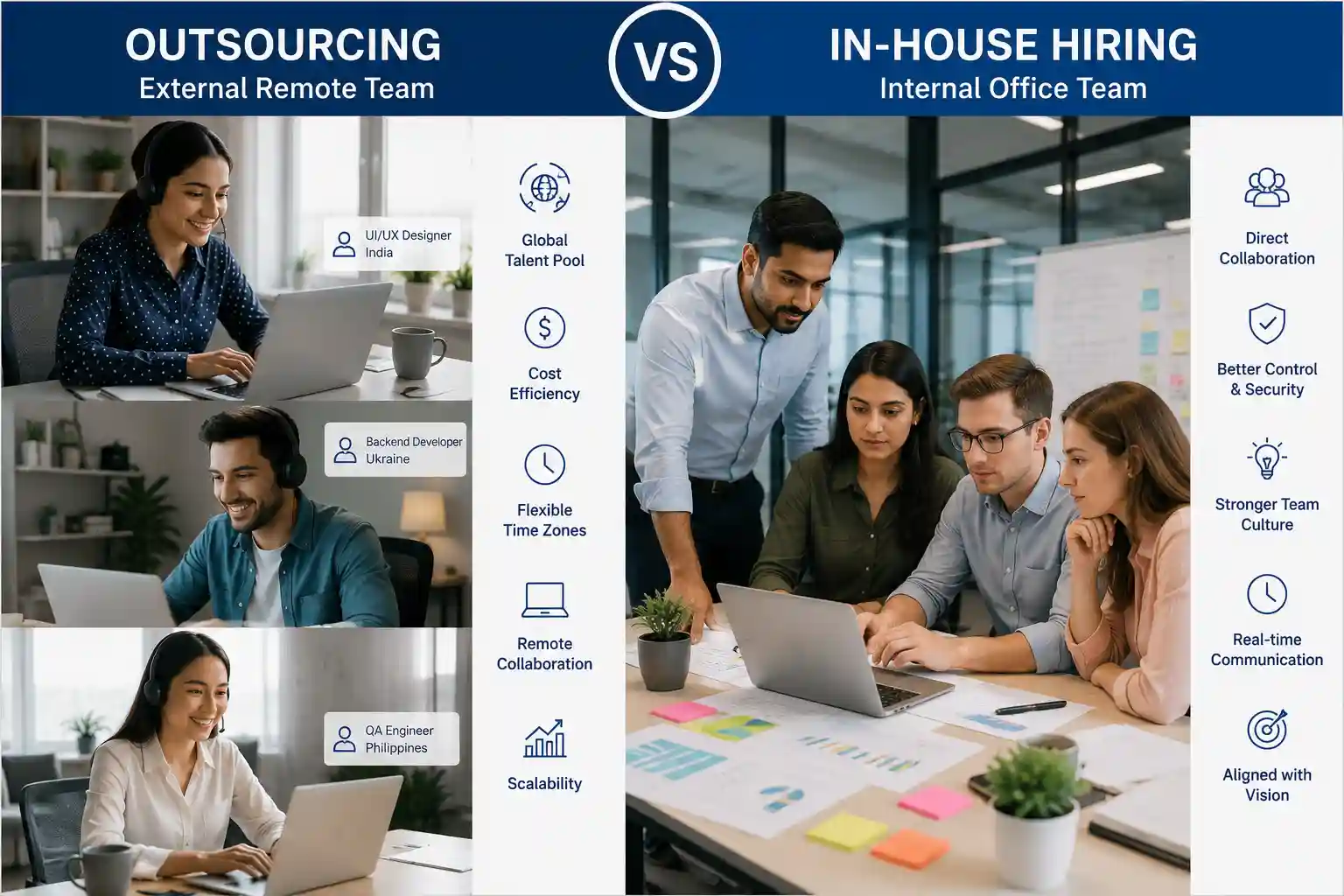
One of the biggest decisions startups face is whether to build an internal team or outsource work to external experts. This choice directly impacts cost, speed, quality, and long-term growth. Understanding outsourcing vs in-house for startups helps founders allocate resources wisely while balancing flexibility and control.
Both approaches have clear advantages and limitations. The smartest startups don’t treat this as a binary choice—they adapt based on stage, budget, and strategic priorities. This guide breaks down the differences, pros and cons, and when to use each model.
What Is Outsourcing and In-House Hiring?
Outsourcing means hiring external individuals, agencies, or vendors to handle specific tasks or projects. These could include development, marketing, design, accounting, or customer support. Outsourced teams work independently and are typically paid per project, hourly, or via contracts.
In-house hiring involves building a team of full-time employees who work directly within your company. These employees are deeply integrated into your business, aligned with your vision, and responsible for long-term execution.
The key difference lies in control and ownership. Outsourcing prioritizes speed and cost efficiency, while in-house teams focus on consistency, alignment, and long-term value.
Pros and Cons of Outsourcing for Startups

Outsourcing is often the go-to option for early-stage startups that need to move quickly with limited resources.
- Lower upfront costs with no need for salaries, benefits, or infrastructure
- Access to specialized expertise across multiple domains
- Faster execution and ability to launch MVPs quickly
- High scalability without long-term commitments
- Flexibility to start, stop, or adjust work based on needs
However, outsourcing also comes with challenges. Startups may have less control over how work is done, communication gaps can occur across time zones or cultures, and long-term dependency on external teams can lead to knowledge gaps. There are also risks related to intellectual property and data security if contracts are not clearly defined.
Outsourcing works best for short-term projects, non-core tasks, and situations where speed is critical.
Pros and Cons of In-House Teams

Building an in-house team provides greater control and long-term stability. Employees are invested in your company’s success and develop a deep understanding of your product and goals.
- Full control over project direction, quality, and timelines
- Strong cultural alignment and team collaboration
- Better protection of intellectual property and sensitive data
- Higher commitment and accountability from employees
- Stronger long-term product development and innovation
The downside is cost and time. Hiring employees requires salaries, benefits, onboarding, infrastructure, and management effort. It also takes time to recruit and build a team, which can slow down product launches. In-house teams may also create bottlenecks if resources are limited.
In-house hiring is best for core business functions, long-term projects, and areas that define your competitive advantage.
Cost Comparison: Short-Term vs Long-Term
Cost is one of the most important factors when comparing outsourcing and in-house models. Outsourcing can reduce upfront costs significantly—often saving two to three times compared to hiring a full-time team.
Outsourced teams typically charge hourly or per project, with rates varying widely depending on expertise. In contrast, in-house employees require ongoing salaries, benefits, and operational costs.
Startups evaluating financial decisions can also explore startup cost optimization strategies to better manage expenses and resource allocation.
The total cost of an employee can reach 125% to 140% of their base salary when including benefits and infrastructure.
However, outsourcing may become expensive over time, especially if projects extend or require ongoing changes. Hidden costs such as delays, miscommunication, and rework can reduce the initial savings.
The key is to evaluate both short-term affordability and long-term sustainability.
Speed and Time-to-Market
Startups often prioritize speed, especially when launching a minimum viable product. Outsourcing provides a clear advantage here. External teams can be assembled quickly and often deliver results faster due to experience and established workflows.
In-house teams take longer to build, but once established, they can iterate faster on complex products because they are deeply integrated into the business. They also require less onboarding for future projects.
If your goal is rapid product launch, outsourcing is typically the better option. If your goal is continuous innovation, in-house teams provide more stability.
Control, Quality, and Intellectual Property
Control is where in-house teams excel. You can directly manage employees, adjust priorities, and ensure alignment with your product vision. This is especially important for startups building proprietary technology or unique business models.
Outsourcing reduces this level of control. While experienced vendors can deliver high-quality work, you may not have full visibility into their processes. Intellectual property protection also becomes a concern, particularly if documentation and contracts are not handled properly.
Founders should also understand intellectual property protection for start ups to safeguard their business assets.
Startups dealing with sensitive data, complex systems, or unique innovations should strongly consider building internal capabilities.
When Startups Should Choose Outsourcing
Outsourcing is the right choice in specific situations:
- Early-stage startups with limited budgets
- MVP development and rapid product launches
- Non-core functions like accounting, marketing, or customer support
- Projects requiring specialized expertise not available internally
Outsourcing allows startups to test ideas quickly and reduce financial risk during the early phases.
When Startups Should Build In-House Teams
In-house hiring becomes more important as the startup grows and stabilizes.
- Core product development and long-term strategy
- Proprietary technology or intellectual property
- Complex projects requiring constant iteration
- Situations where consistent quality and control are critical
As revenue becomes predictable, investing in an internal team becomes more feasible and valuable.
The Hybrid Model: Best of Both Worlds
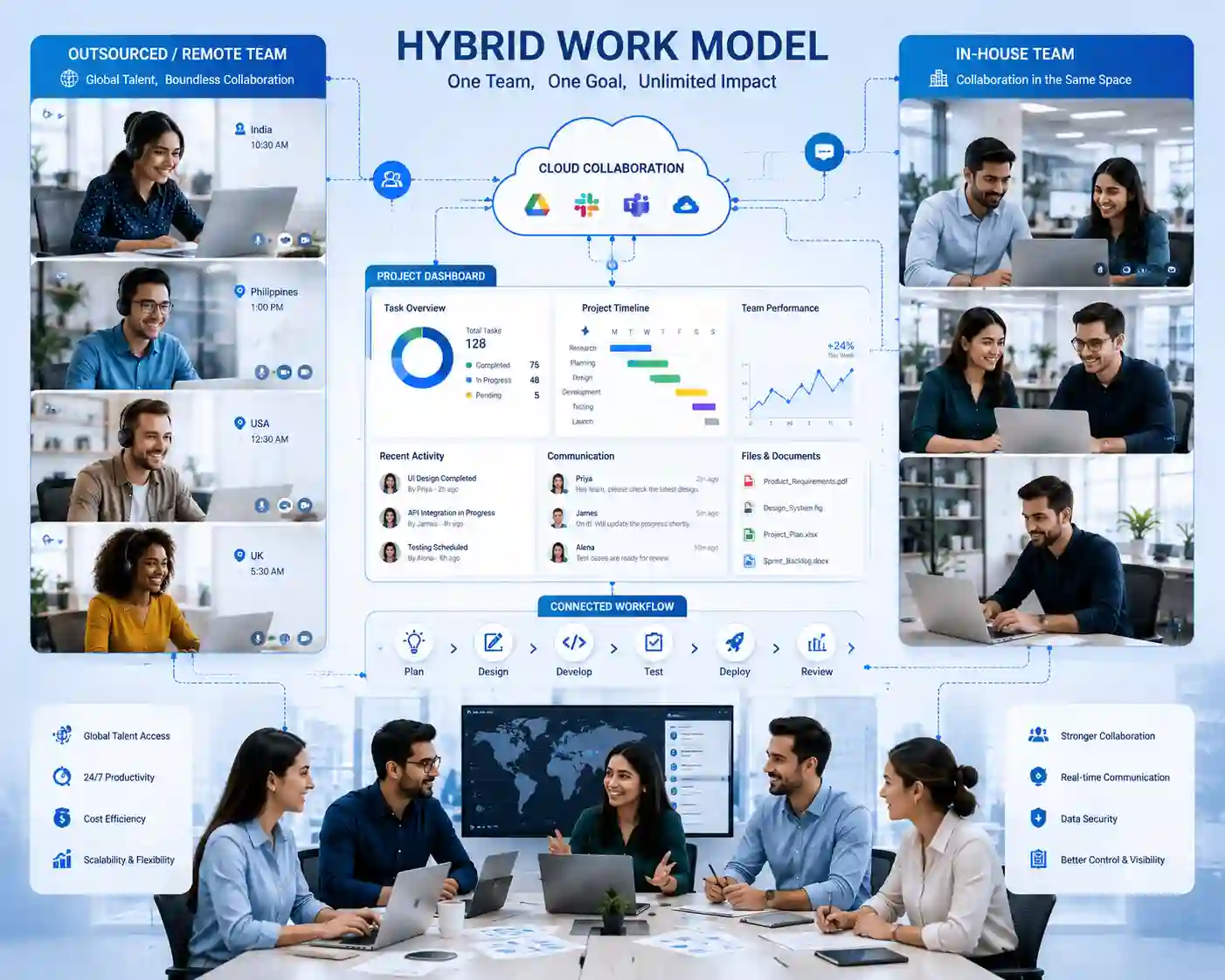
Most successful startups use a hybrid approach. They combine outsourcing and in-house hiring to balance speed, cost, and control.
In this model, the in-house team focuses on strategy, product vision, and core development, while outsourced teams handle specialized or resource-heavy tasks. This approach allows startups to remain agile while building internal strength.
A phased transition often works best. Start by outsourcing to launch quickly, then gradually build an in-house team as the business grows. This ensures knowledge transfer, reduces dependency, and improves long-term efficiency.
Signs It’s Time to Move In-House
There are clear indicators that a startup should shift from outsourcing to building an internal team.
Consistent revenue growth is one of the strongest signals. When the business can support long-term costs, investing in employees becomes more viable. Increasing project complexity, communication challenges, and knowledge loss from external teams are also signs that internal capabilities are needed.
If outsourcing starts causing delays, inconsistent quality, or higher long-term costs, it is time to reassess your strategy.
Frequently Asked Questions
Is outsourcing cheaper than in-house for startups?
Yes, outsourcing is usually cheaper in the short term because it avoids salaries, benefits, and infrastructure costs. However, long-term costs may increase depending on project scope and duration.
When should a startup stop outsourcing?
Startups should consider building an in-house team when they have stable revenue, need better control, and want to retain knowledge and intellectual property.
What is the biggest risk of outsourcing?
The biggest risks include loss of control, communication challenges, inconsistent quality, and potential intellectual property concerns.
Can startups use both outsourcing and in-house teams?
Yes, a hybrid model is often the best approach. It allows startups to balance flexibility, cost efficiency, and long-term growth.
Which is better for MVP development?
Outsourcing is usually better for MVP development because it is faster and more cost-effective, allowing startups to validate ideas quickly.
Building a Scalable Team Strategy
Choosing between outsourcing vs in-house for startups is not about picking one model forever. It is about using the right approach at the right time. Outsourcing helps you move fast and save costs in the early stages, while in-house teams provide control, stability, and long-term growth.
The most effective strategy is to evolve with your business. Start lean with outsourcing, then gradually build a strong internal team for core functions. Combining both models ensures flexibility without compromising quality.
As you refine your hiring and operational decisions, understanding related strategies like vendor vs freelancer for startups will help you build a balanced, scalable workforce that supports your startup’s success.
